Military
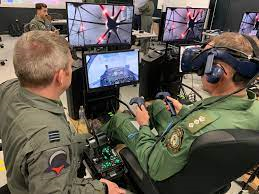
Dangerous jobs have used VR to simulate a situation and capture trainees/participants reactions and skills. Some of the most dangerous jobs around are with the military. The US Air Force in April 2019 performed an experiment. Normally training a pilot takes 12 months in a $4.5 Million simulator. Could it be done faster with VR and biometrics? The answer was yes[11]. Pilots were trained in four months instead of 12 using a $1,000 head mounted display and biometrics that measured the users' pupils and heart rate. Additionally, the VR setup allows the air force to train the pilots on multiple planes on the same equipment.
Painting Airplanes[12] doesn't sound like something that would be a good candidate for VR but the US Air Force paid $30,000 to create a simulator to do that protecting trainees from environmental hazards, reducing supplies and correcting errors in VR. The US Air Force will not give an official cost savings estimate, but they are on record for saying the VR project was a ‘bargain'.
Education - High School

With COVID and the world becoming more connected, a new high school in Florida was created. The difference is the entire school is run in VR[13]. This is not another zoom school, but one where students gather with their virtual classmates and teacher in a virtual classroom to interact with each other, and the course material. The ability to hold human organs in biology class or to make new chemicals in chemistry make VR school an interactive experience.
Maybe VR is only a tool for one or two classes? Learning the habitat and habits of sharks in the ocean or flying beside eagles is not something that can be done in a regular classroom but it is some of the lessons that are available to students with the right courseware[14]. Studying biology without the need to dissect an animal is also a blessing to High School students and animals alike! Microsoft has developed a virtual frog that can be dissected as part of a biology course to substitute for the real thing[15]
Future firefighters benefit from training on virtual fires[16] before going up the real thing. Fern Creek High School Jefferson County in Kentucky is using VR to enhance their Fire Science program to give the students training that would normally take six months after graduation during the school year.
Medical
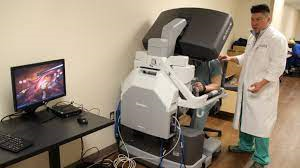 Doctors must perform hours of surgery to keep the skills needed to perform well. Performing the surgery virtually
the day before the actual surgery to see how the patient may react (by integrating their x-rays, MRI and other
information) can help positive patient outcomes[17] and allow for practice in more realistic environments. Student
doctors can practice on virtual patents and have the operation reviewed at all angles. VR-trained surgeons had a
230% boost in their overall performance compared to their traditionally trained counterparts. In 2016 a VR surgery
was performed by Dr. Ahmed for anyone to review worldwide[18].
Doctors must perform hours of surgery to keep the skills needed to perform well. Performing the surgery virtually
the day before the actual surgery to see how the patient may react (by integrating their x-rays, MRI and other
information) can help positive patient outcomes[17] and allow for practice in more realistic environments. Student
doctors can practice on virtual patents and have the operation reviewed at all angles. VR-trained surgeons had a
230% boost in their overall performance compared to their traditionally trained counterparts. In 2016 a VR surgery
was performed by Dr. Ahmed for anyone to review worldwide[18].